Tuesday, January 4, 2011

SecureWorks Deal Gives Dell Managed Security


Managed security will be added to Dell's IT-as-a-service offering with its agreement to acquire SecureWorks. Best known for its security services, SecureWorks has made headway into countering threats for the financial services industry and has a wide variety of clients. Dell said SecureWorks is part of its strategy to simplify IT management.

Dell on Tuesday inked a deal to acquire security Relevant Products/Services firm SecureWorks. The acquisition expands Dell's IT Relevant Products/Services-as-a-service offering for the financial-services industry. Terms of the deal were not disclosed.
SecureWorks is best known for its managed security services, security and risk consulting, and threat intelligence. The firm counts Fortune Global 500 companies, midsize businesses, financial services, utilities, health care, retail and manufacturing companies among its clients.
In announcing the acquisition, Peter Altabef, president of Dell Services, said the frequency and sophistication of technology attacks and attempts to access data Relevant Products/Services require reliable, capable and innovative information security.
"SecureWorks is a recognized industry leader in information security services, and its offerings and expertise will immediately enhance our solutions portfolio," Altabef said. "We look forward to welcoming SecureWorks team members -- who bring their passion and dedication to serving clients with best-in-class security services -- to Dell and our clients."
Anatomy of SecureWorks
SecureWorks clients rely on its technology to reduce risk, improve regulatory compliance Relevant Products/Services, and lower costs of managing IT security. The company's proprietary threat-management platform is scalable and integrates with client environments. And its counterthreat research team works to help protect clients across multiple industries from global IT threats.
SecureWorks processes more than 13 billion security events and sees more than 30,000 malware specimens each day. The company has more than 1,500 banks and credit unions as managed security clients and is protecting trillions of dollars in financial assets.
"Dell's global scale Relevant Products/Services and relationships with clients provides a tremendous opportunity to rapidly expand SecureWorks' business," said Michael Cote, CEO and chairman of SecureWorks. "With Dell's commitment to our clients, our team and our market, I am confident that SecureWorks will flourish as part of the Dell Services organization and that our clients will continue to be well-served and well-protected by the services on which they rely."
A Lucrative Niche
The SecureWorks acquisition is Dell's latest strategic investment in its portfolio of enterprise Relevant Products/Services-class IT-as-a-service solutions. Dell said building its capabilities as a managed security service provider (MSSP) is an important next step in its strategy to help clients drive better efficiency across the enterprise and dramatically simplify IT infrastructure management.
Dell has had a big footprint in the health-care IT-services market for years, noted Charles King, principal analyst at Pund-IT, but SecureWorks is an interesting play with a different kind of industry focus. SecureWorks has made headway into the financial-services space.
"This is representative of the sort of acquisition strategy that we've been seeing from Dell since Michael Dell returned to the company," he said. "Getting SecureWorks creates some really interesting future market opportunities for Dell, but it makes them a big player in one of the most lucrative sectors. This is a great deal for Dell."
Read more...

Monday, January 3, 2011

Micron's ClearNAND: 25nm + ECC, Combats Increasing Error Rates

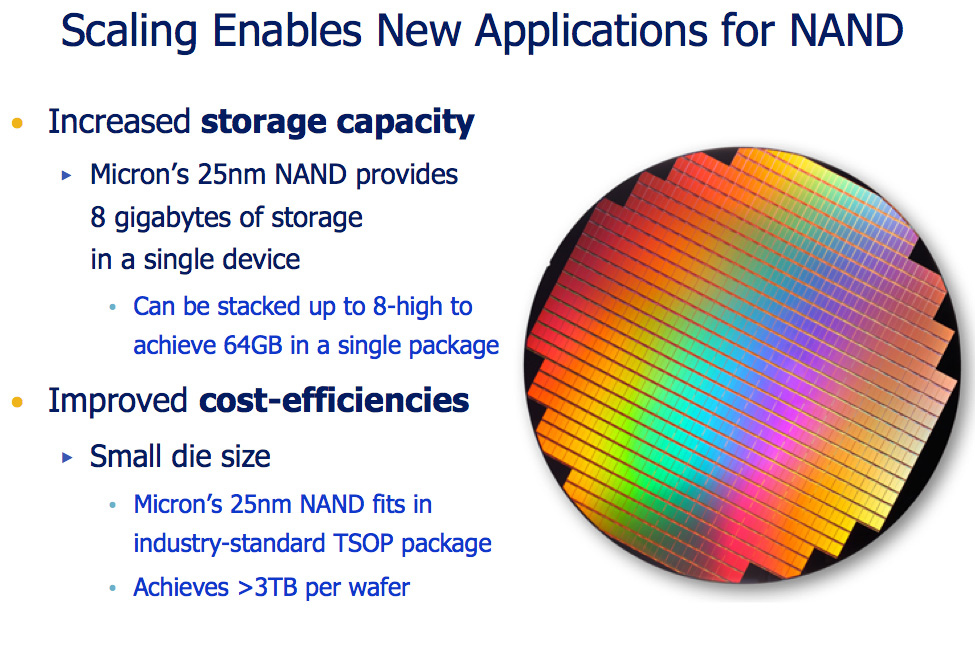
Eleven months ago Intel and Micron, jointly as IMFT, announced intentions to move to 25nm NAND by the end of 2010. For the past few months, IMFT has been shipping 25nm NAND although none of it has ended up in the high performance SSDs we love to cover just yet.
The problem, as with a jump to any new manufacturing node, has to do with yields. In the microprocessor space, new processes generally mean you can’t reach your clock targets and you may use more power than you’d like. The more experience you have in working with the process the more you can get these two variables under control and eventually you have a technology you can ship to the market.
The same is true with NAND, although the vectors of improvement are a bit different. Rather than clock speed and power (although both are affected) the main focus these past few months has been increasing endurance and reducing uncorrectable bit error rate.
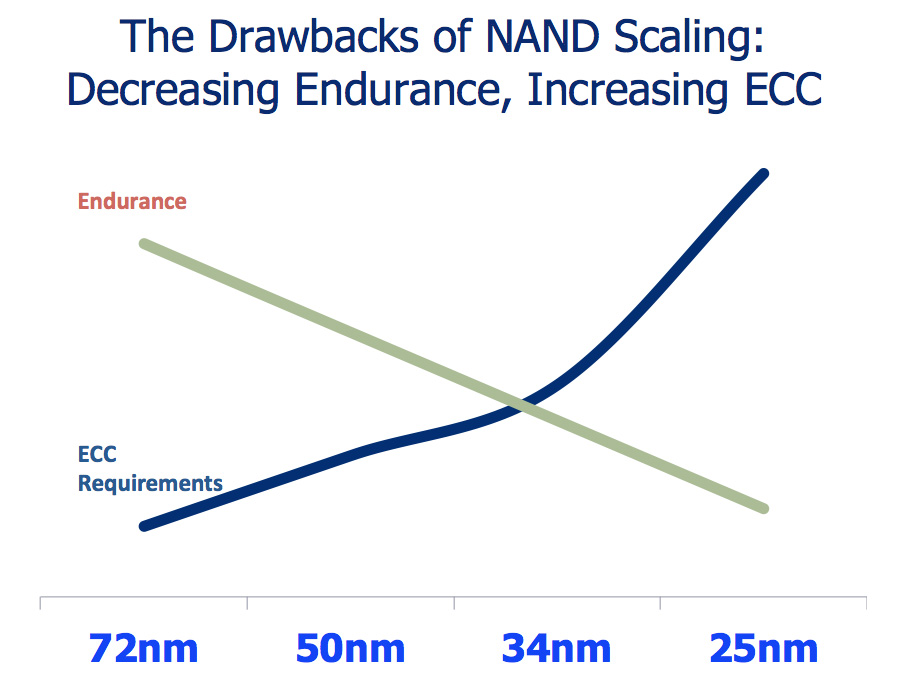
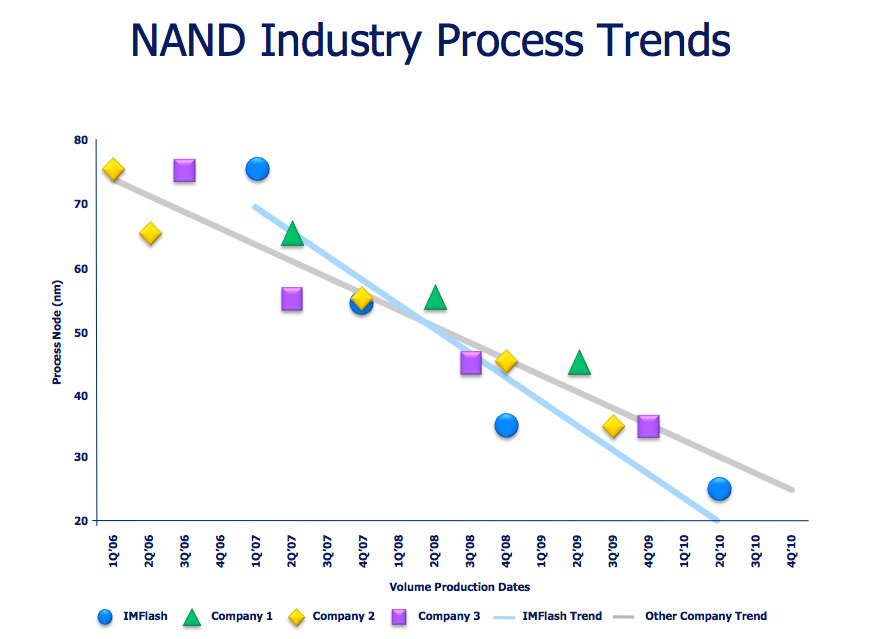
When I first started reviewing SSDs IMFT was shipping 50nm MLC NAND rated at 10,000 program/erase cycles per cell. As I mentioned in a recent SSD article, the move to 3xnm cut that endurance rating in half. Current NAND shipping in SSDs can only last half as long, or approximately 5,000 program/erase cycles per cell. Things aren’t looking any better for 25nm. Although the first 25nm MLC test parts could only manage 1,000 P/E cycles, today 25nm MLC NAND is good for around 3,000 program/erase cycles per cell.
The reduction in P/E cycles is directly related to the physics of shrinking these NAND cells; the smaller they get, the faster they deteriorate with each write. Remember this diagram?
That’s an N-channel MOSFET, the building block of a NAND memory cell. Electrons travel through the tunnel oxide and make their way to the floating gate when a NAND cell is written to. The electrons are removed when a cell is erased. Each round trip is a single program/erase cycle. The process actually weakens the tunnel oxide. The smaller the tunnel oxide, the weaker it becomes, hence the decreasing p/e cycles I mentioned above.
Thankfully this doesn’t have to mean that a 3xnm SSD will die quicker than a 50nm SSD. Moore’s Law guarantees that our SSD controllers can grow in complexity and performance alongside each NAND generation. In theory, a better controller could drive write amplification lower and thus use those program/erase cycles more efficiently. This is exactly what we have seen thus far. SandForce’s SF-1200 is the perfect example of a controller-based solution to the problem of decreasing endurance with smaller geometry NAND. Even new controllers from Indilinx, Toshiba and Samsung have managed to reduce write amplification and increase performance to combat decreasing endurance.

How SandForce deals with the problem of reduced endurance and increased error rates
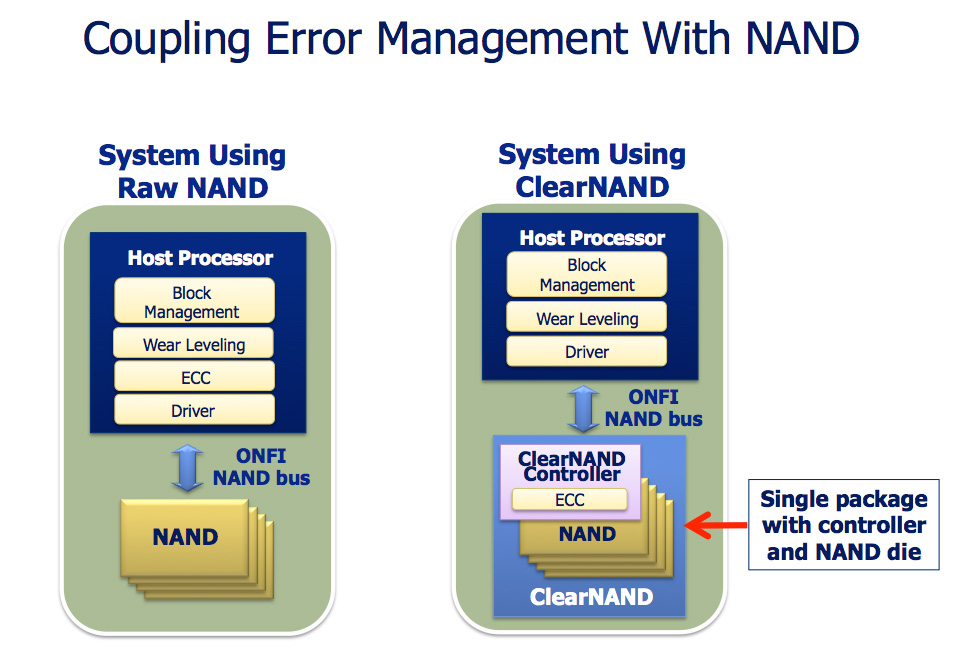
Error rates also skyrocket as a function of process geometry. The supply-demand-like curve above shows just that. SandForce integrates ECC/CRC into its controller as well as enables data redundancy across all NAND in its drives in order to combat increasing error rates with smaller geometry flash. The end result is a very forward looking, sophisticated and expensive SSD controller. What Micron plans to offer however is an alternative. It’s called ClearNAND:
The idea is simple. Instead of placing the burden of dealing with increasing error rates on the controller, Micron will internalize the problem and equip each NAND device with an ECC controller.
The NAND will still appear to be an ONFI complaint device with the same number of pins as a regular 25nm ONFI NAND device (a single unused pin, VDDI, is now put to use in ClearNAND). The bus interface remains the same and NAND controller manufacturers don’t have to do anything differently.
On each ClearNAND device you get a 24-bit BCH ECC engine, although Micron says that in another generation or two we’ll start seeing more exotic ECC algorithms.
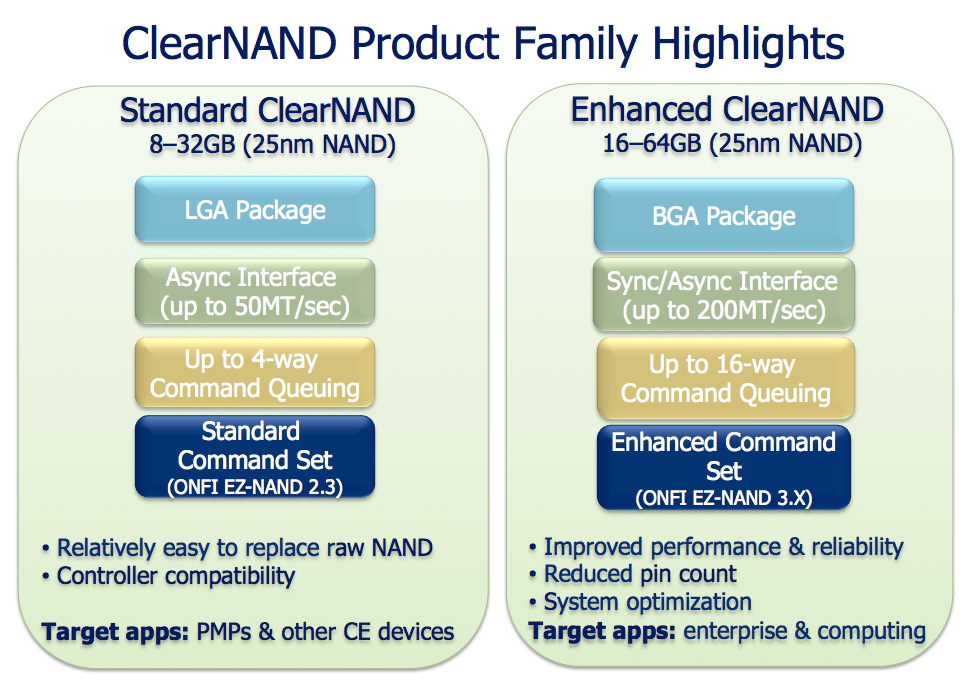
ClearNAND will be available starting at the 25nm node in two versions: standard and enhanced. Standard ClearNAND devices are low performance, you only get up to 50MB/s per device and up to 4 simultaneous read/write ops to the device at the same time. Enhanced ClearNAND doubles maximum capacity from 32GB to 64GB per device, quadruples interface bandwidth (200MB/s) and supports up to 16 simultaneous read/write ops. Enhanced ClearNAND would be the NAND of choice for an SSD, while Standard ClearNAND would be better suited for an iPod or smartphone for example.
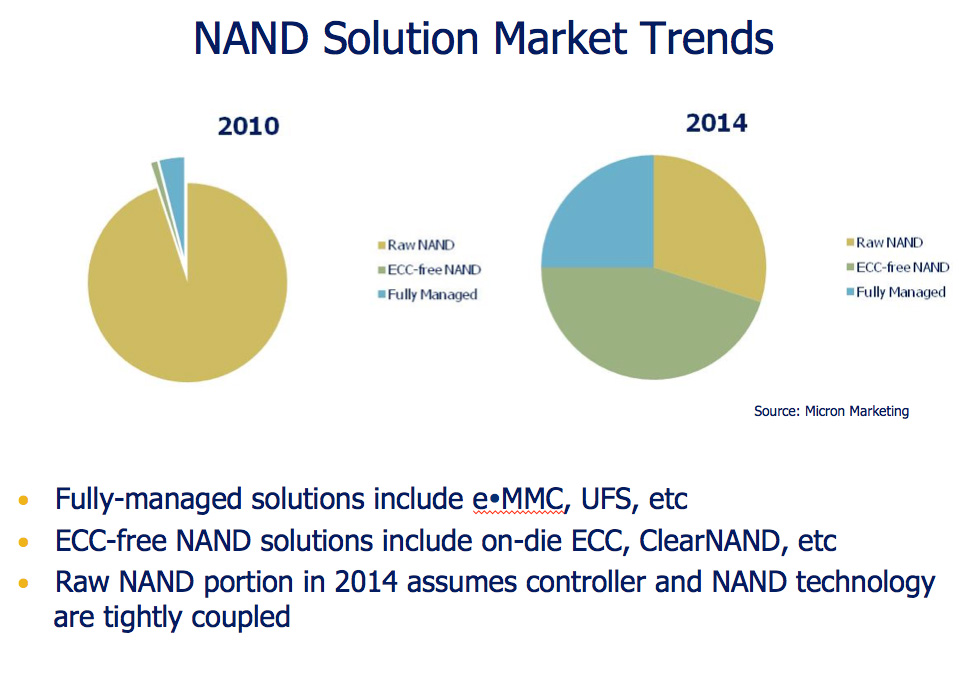
Raw 25nm NAND will still be available, Micron is simply offering ClearNAND as a solution to those customers who don’t want to integrate ECC engines into their controllers.
Today the need for something like ClearNAND isn’t huge, however in the next few years Micron expects ECC equipped NAND to be the most prevalent form of NAND in the market. This would make sense as error rate goes up as process size decreases, however it does assume that the ECC requirements can’t or aren’t handled at the controller level in the future.
There’s obviously a price premium associated with ClearNAND. However since we aren’t a customer of Micron, we aren’t exactly privy to specific pricing information.
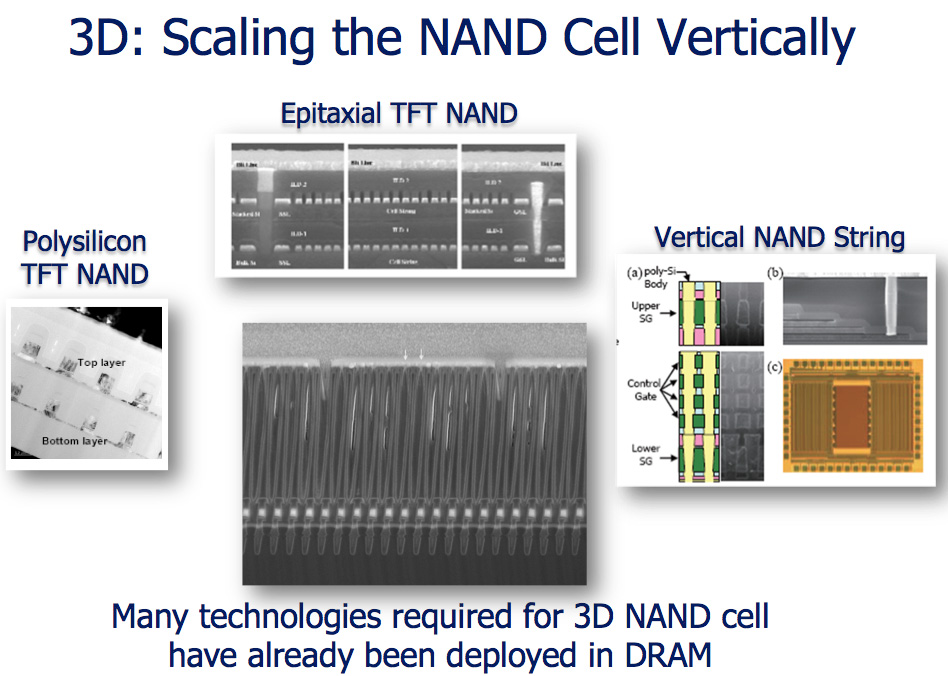
Eventually we will hit a physical wall with NAND scaling. Micron reaffirmed its commitment to research into technologies that would extend the lifespan of NAND (e.g. 3D die) or potentially augment its role in a system (e.g. phase-change memory). That’s still a few generations out though.
I don’t expect to see the first consumer SSDs to use 25nm NAND (ClearNAND or raw) until 2011. Intel’s 3rd generation X25-M will be one of the first (if not the first) and is currently scheduled to ship in Q1 2011.
Read more...

Verizon Flips the Switch on its 4G/LTE Network December 5, $50 for 5GB

Verizon just announced that on this Sunday, December 5, Verizon will launch its LTE network in the US. The network will launch in 39 cities around the country (listed below) alongside LG's VL600 USB 3G/LTE modem.
The modem will be available in Verizon stores for $99.99 after a $50 rebate with a new 2-year agreement. Service will set you back $50 per month for up to 5GB of data transfers or $80 for 10GB. Overages are billed at $10 per GB.
Verzion stated that speeds on a fully loaded LTE network will range between 5 - 12Mbps down and 2 - 5Mbps up. Latency should be roughly half what it is today on VZW's 3G network.
We'll see more LTE modems ship before the end of the year and LTE enabled smartphones towards the middle of 2011, with devices being announced at CES in January.
What about the rest of the country? Verizon plans to have its current 3G network covered by LTE before the end of 2013.

Verizon Wireless 4G LTE Initial Major Metropolitan Area Deployment (Dec. 5, 2010) 
Akron, Ohio 
Athens, Georgia 
Atlanta, Georgia 
Baltimore, Maryland 
Boston, Massachusetts 
Charlotte, North Carolina 
Chicago, Illinois 
Cincinnati, Ohio 
Cleveland, Ohio 
Columbus, Ohio 
Dallas-Ft. Worth Metroplex, Dallas, Texas 
Denver, Colorado 
Ft. Lauderdale, Florida 
Houston, Texas 
Jacksonville, Florida 
Las Vegas, Nevada 
Los Angeles, California 
Miami, Florida 
Minneapolis/Saint Paul, Minnesota 
Nashville, Tennessee 
New Orleans, Louisiana 
New York, New York 
Oakland, California 
Oklahoma City, Oklahoma 
Orlando, Florida 
Philadelphia, Pennsylvania 
Phoenix, Arizona 
Pittsburgh, Pennsylvania 
Rochester, New York 
San Antonio, Texas 
San Diego, California 
San Francisco, California 
San Jose, California 
Seattle/Tacoma, Washington 
St. Louis, Missouri 
Tampa, Florida 
Washington, D.C. 
West Lafayette, Indiana 
West Palm Beach, Florida 

Verizon Wireless 4G LTE Initial Commercial Airport Deployment (Airport Name, City, State) Dec. 5, 2010 
Austin-Bergstrom International, Austin, Texas 
Baltimore/Washington International Thurgood Marshal, Glen Burnie, Maryland 
Bob Hope, Burbank, California 
Boeing Field/King County International, Seattle, Washington 
Charlotte/Douglas International, Charlotte, North Carolina 
Chicago Midway International, Chicago, Illinois 
Chicago O’Hare International, Chicago, Illinois 
Cincinnati/Northern Kentucky International, Covington, Kentucky 
Cleveland-Hopkins International, Cleveland, Ohio 
Dallas Love Field, Dallas, Texas 
Dallas/Fort Worth International, Fort Worth, Texas 
Denver International, Denver, Colorado 
Fort Lauderdale/Hollywood International, Fort Lauderdale, Florida 
George Bush Intercontinental/Houston, Houston, Texas 
Greater Rochester International, Rochester, New York 
Hartsfield-Jackson Atlanta International, Atlanta, Georgia 
Honolulu International, Honolulu, Hawaii 
Jacksonville International, Jacksonville, Florida 
John F. Kennedy International, New York, New York 
John Wayne Airport-Orange County, Santa Ana, California 
Kansas City International, Kansas City, Missouri 
La Guardia, New York, New York 
Lambert-St. Louis International, St. Louis, Missouri 
Laurence G. Hanscom Field, Bedford, Massachusetts 
Long Beach/Daugherty Field, Long Beach, California 
Los Angeles International, Los Angeles, California 
Louis Armstrong New Orleans International, Metairie, Louisiana 
McCarran International, Las Vegas, Nevada 
Memphis International, Memphis, Tennessee 
Metropolitan Oakland International, Oakland, California 
Miami International, Miami, Florida 
Minneapolis-St. Paul International/Wold-Chamberlain, Minneapolis, Minnesota 
Nashville International, Nashville, Tennessee 
New Castle, Wilmington, Delaware 
Newark Liberty International, Newark, New Jersey 
Norman Y. Mineta San Jose International, San Jose, California 
North Las Vegas, Las Vegas, Nevada 
Orlando International, Orlando, Florida 
Orlando Sanford International, Sanford, Florida 
Palm Beach International, West Palm Beach, Florida 
Philadelphia International, Philadelphia, Pennsylvania 
Phoenix Sky Harbor International, Phoenix, Arizona 
Phoenix-Mesa Gateway, Mesa, Arizona 
Pittsburgh International, Pittsburgh, Pennsylvania 
Port Columbus International, Columbus, Ohio 
Portland International, Portland, Oregon 
Rickenbacker International, Columbus, Ohio 
Ronald Reagan Washington National, Arlington, Virginia 
Sacramento International, Sacramento, California 
Salt Lake City International, Salt Lake City, Utah 
San Antonio International, San Antonio, Texas 
San Diego International, San Diego, California 
San Francisco International, San Francisco, California 
Seattle-Tacoma International, Seattle, Washington 
St. Augustine, Saint Augustine, Florida 
St. Petersburg-Clearwater International, Clearwater, Florida 
Tampa International, Tampa, Florida 
Teterboro, Teterboro, New Jersey 
Trenton Mercer, Trenton, New Jersey 
Washington Dulles International, Dulles International Airport, Washington, D.C. 
Will Rogers World, Oklahoma City, Oklahoma 
William P. Hobby, Houston, Texas
Read more...

Vizio Will Offer Phone, Tablet in a Crowded Market


A unified multiscreen experience is the goal as HDTV maker Vizio gets ready to offer the Via Phone and Via Tablet in a crowded market. Both Android-powered Vizio devices will include a universal remote control for home entertainment. Vizio plans to demonstrate both the Via Phone and Via Tablet at this week's Consumer Electronics Show.

What do you get when one of the leading LCD HDTV manufacturers gets into the smartphone and tablet business? That's yet to be seen, but Vizio is getting ready to find out. The company is the latest technology vendor to build mobile devices.
Dubbed Via Phone and Via Tablet, the mobile devices will soon be part of the Via Plus ecosystem, described as the next generation of Vizio Internet apps that feature a single user experience across multiple consumer electronics devices, including Vizio HDTVs, Blu-ray players, smartphones and tablets.
"Both the Via phone and tablet feature the highest performance coupled with innovative features that tie them into the media-consumption experience," said Matthew McRae, CTO at Vizio. "And by integrating the Via Plus user experience also found on our next-generation TVs and Blu-ray devices, Vizio is delivering the multiscreen, unified ecosystem others have talked about for years and never delivered."
Speccing the Via
That's the value proposition in theory. What the new devices are in reality remains to be seen. For now Vizio is offering specs. The Via Phone features a one-gigahertz processor, a four-inch high-resolution touchscreen, 802.11n Wi-Fi and Bluetooth connectivity, GPS, a microSD card slot for memory expansion, and HDMI output with HD video playback. It also features a front-facing camera for video chats and a five-megapixel rear camera for photos and HD video capture.
The Via Tablet also features a one-gigahertz processor with an eight-inch high-resolution capacitive touchscreen, 802.11n Wi-Fi and Bluetooth connectivity, GPS, a microSD card slot for additional memory, HDMI output with HD video playback, and a front-facing camera for video chats. It also boasts a unique three-speaker design for stereo audio in both portrait and landscape modes.
Both devices include a built-in IR blaster with universal remote control for quick access to a home theater or nearly any electronics device in the home. Both run on Google's Android operating system, which will allow users access to thousands of apps through the Android Market. Vizio will demonstrate the new devices at the Consumer Electronics Show, which begins later this week.
The Value Proposition
"The open question that I have is how Vizio expects to succeed, particularly in the cell-phone business. There are an awful lot of people crowding into that space from other places, especially PC vendors trying to become phone vendors as the PC goes mobile," said Avi Greengart, an analyst at Current Analysis. "But they are finding that the cell-phone business, particularly in the U.S., is controlled by carrier shelf space. If you don't have relationships with carriers, you are not going to get volume sales. I haven't seen anything from Vizio about carriers."
Greengart suspects Vizio may be planning to sell its devices through existing retail outlets that carry its HDTVs, like Best Buy and Costco. But he's not sure yet how the company plans to convince customers to buy a Via product over an iPad or the new Motorola tablet.
"I assume there is going to be some software layer that gives you a better experience if you have a Vizio television or Vizio phone or tablet. That could be a powerful story," Greengart said. "The reason you buy a Vizio TV at retail is because it's cheaper. It's hard to get cheaper than LG or Samsung on phones."
Read more...

Sunday, January 2, 2011

SuperTalent Introduces USB 3.0 Virtual PC Flash Drives


SuperTalent are so confident in their speeds that they have teamed up with Ceedo, to provide Ceedo Personal at a reduced cost. The Ceedo Personal application allows the user to install any Windows applications onto the portable drive, and these applications can then be used on any compatible Windows PC, saving all the unique settings that user is accostomed to.  We tried out the software on a couple of systems, having no issues on one, and a few quirks on the other. The quirky system needed a fiddle with security settings and some of the browser plug–ins disabled before the Ceedo Programs list would open.   However, download tabs were greyed out, preventing us from installing anything from Ceedo’s application list. The fix is probably a simple one, but not something we’ve stumbled across to date. Just a heads up to check out the free 45 day trial here for compatibility and ease of use before you buy.
32GB of storage in a thumb drive size...
 
 
16GB Express RAM CACHE - USB 3.0 and 2.0 Performance figures...

Pricing of the drive and software bundles is as follows:

Unfortunately, these thumb drives aren't cheap. Step over to the 32GB and 64 GB models and you're getting close to ADATA N004 64GB and 128GB USB 3.0 SSD prices, sans the cost of Ceedo.  Obviously the form factor comes into play for easier portability, but whether or not that's worth a $70 hike in price at 64GB capacity is another matter. There's also more direct competition from the likes of Kingston with their DataTraveller Ultimate series of flash drives (JMF controller based), however, we're not sure what controller SuperTalent are using at present so don't know how the two will compare in a head-to-head.
SuperTalent have posted up a Youtube for those of you interested in learning more:

Read more...
Logitech Laptop Speaker Z305


Before we get into the nitty-gritty of reviewing the Z305 proper, it's important to get a couple of things out of the way. First, this is a subjective review. It's simply too difficult to justify getting together the necessary equipment (not to mention space) to do proper objective measurements of sound hardware, especially when you're sharing a tiny apartment with someone. That, and this is a $59 speaker, so anyone looking for hard-hitting coverage of a consumer-grade kit designed solely to replace crappy laptop speakers may take their sound a little bit too seriously.
Second, this is our last audio review for a while. You spoke: we listened. Subjective reviews are all we're really equipped to handle and that seems to infuriate exactly half of our readership. Since we actually like you and really want you to come back and continue reading, audio reviews are falling by the wayside for the foreseeable future. If and when we take another shot at audio, we'll be adding the necessary equipment and expertise to do it right.
Now, all that out of the way, down to business. The Logitech Laptop Speaker Z305 is essentially a pair of speakers in a single barrel that clamps to the top of a laptop screen similar to a webcam, and from there they connect via a short USB cable that handily folds into the body of the speakers. Setup is quick and easy and no drivers need to install. There's an additional minijack in the body of the barrel for connecting outside audio sources, but the Z305 is still going to require power from the USB port.
On the whole, the Z305 is a fairly elegant solution. The volume buttons built into the bar are basically just shortcuts for the software-controlled volume level in Windows. It's all plug-and-play, very seamless, and in many ways the clamp-on solution actually seems more logical than the wireless Z515 speakers we reviewed. Truthfully when we were offered the Z515 and Z305 to review, this was the product I really wanted to check out. At $60 MSRP it's much less glamorous, but it also struck me as being the more practical of the two. So how does it sound?
Read more...

The Nokia E5 Review: A Cheaper E72


When Anand first asked if I wanted to review the Nokia E5-00 (referred to as E5 henceforth), I wasn’t sure what to say. Having almost exclusively used Nokia’s Symbian based smartphones for the first half of this decade, I wasn’t sure if I was supposed to be happy to meet an old friend after a long time, or loathe it thinking of the reasons I decided to move away from the platform in the first place. But then again, I realized I may actually be in a better position than some to review this device because of my prior experience with the platform. So jostling for front-page area on AT along with other, decidedly more exciting, better spec’d and feature-packed smartphones is the almost shockingly simple Nokia E5.
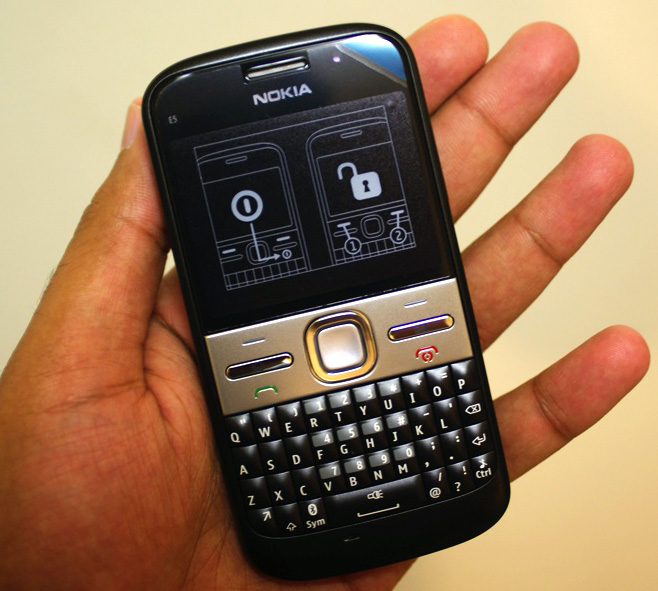
Coming in at 115 x 58.9 x 12.8 mm and weighing 126 g, the E5 feels great in your hands
Joining Nokia’s business-centric E Series line of smartphones is the E5. Pegged by Nokia as the successor to the higher end Nokia E72, my impressions of the phone lead me to believe that it is more of an upgrade to the lower end E63 than a replacement for the E72; it fits right between the two.  But it is in fact a worthy upgrade; the E5 is the only Series 60 phone to date with 256MB RAM onboard. It also has an ARM11 SoC running at a relatively speedy (by Nokia's standards) 600Mhz, shared with the E72. This can be attributed to Symbian’s thriftiness when it comes to resource consumption, but it is also testament to the fact that the software platform running underneath is unquestionably previous-gen and as such, doesn’t need the latest and greatest to get going.
Read more...

Saturday, January 1, 2011

Corsair AX750 80 Plus Gold: Putting Corsair's Best to the Test


With sales of around 150,000 PSUs a month, Corsair is one of the largest vendors for retail power supplies. Corsair got in earlier than most other lateral entrants like GeIL or A-DATA, and their time in the market has enabled them to gather a lot of experience even if they don't have their own factory. In recent times they've used CWT, Seasonic and Flextronics as their PSU ODMs.
A few weeks ago Corsair presented their newest PSUs, the AX series. The goal is to provide performance, quality and high efficiency, this is apparently the best power supply Corsair can offer at the moment. Today we'll look at the AX750; is the 80Plus Gold certificate justified? And what other useful features does it provide?
The AX750 and 850W models are based on a Seasonic design (X-400FL and/or X-760) with some modifications in the details. For example Corsair uses flat peripheral cables and offers a 7-year warranty. They don't have the PWM fan from the original (it's an Antec patent), but they use the same kind of fan regulation; we will see that later in our test. Interesting features include the fully modular cable management and a silent, semi-passive fan control. Here's a complete rundown of the features (and marketing material).
Corsair Professional Series Gold AX750 features:
  • Supports the latest ATX12V v2.31 and EPS 2.92 standards and is backward compatible with ATX12V 2.2 and ATX12V 2.01 systems
  • An ultra-quiet 120mm double ball-bearing fan delivers excellent airflow at an exceptionally low noise level by varying fan speed in response to temperature
  • 80 Plus Gold certified to deliver at least 90% efficiency at 50% load
  • Active Power Factor Correction (PFC) with PF value of 0.99
  • Universal AC input from 90~264V
    • No more hassle of flipping that tiny red switch to select the voltage input!
  • A dedicated single +12V rail offers maximum compatibility with the latest components
  • Over-voltage and over-current protection, under-voltage protection, and short circuit protection provide maximum safety to your critical system components
  • High-quality Japanese capacitors provide uncompromised performance and reliability
  • Completely modular cable system allows you to use only the cables you need
    • Power supply upgrade and replacement is easy, as the cables only need to be disconnected at the power supply
  • Low-profile, flat cable design reduces air friction and helps maximize airflow through your computer's chassis
  • A seven year warranty and lifetime access to Corsair's legendary technical support and customer service
  • Dimensions: 150mm(W) x 86mm(H) x 160mm(L)
  • MTBF: 100,000 hours
  • Safety Approvals: UL, CUL, CE, CB, FCC Class B, TÜV, CCC, C-tick
The 750W version is currently on sale for $150 online, with an additional $20 mail-in rebate. That's not too shabby, considering the older Seasonic X-750 still costs $170. However, we'll need to see if the quality of the AX750 matches the X-750 before we can determine if the reduced price makes this a better buy.
Read more...

Sony NSZ-GT1 Blu-Ray Player with Google TV Review


Offering unprecedented content aggregation via a consumer oriented federated search experience, the Google TV (GTV) platform is a fascinating product with incredible promise. Subsequent to its launch amidst high expectations, users have slowly come to terms with the capabilities of the software as well as the underlying hardware platform.

Without doubt, the Logitech Revue was the flagship product for Google TV at launch. However, many of its users are finding it hard to justify a dedicated device for just the functionality provided by Google TV. A detailed review of the Revue will follow in the coming weeks. However, the unanimous opinion amongst the editors at AnandTech is that Google TV could only be justified as a bundled value add-on for already existing CE devices in a HT setup. Consumers would probably be willing to pay for Google TV on devices such as TVs, Blu-Ray players, media streamers, STBs or even AV receivers.

Sony was one of the first companies to jump onto the Google TV bandwagon, and they debuted some TVs and even a Blu-Ray player with Google TV inbuilt around the same time as the launch of the Logitech Revue. Today, we’re evaluating the Sony NSZ-GT1 Blu-ray player as a consumer electronics (CE) device and as an example of the GTV platform.
Specifications of the Sony NSZ-GT1 Blu-Ray Player
Dimensions 13” (W) x 2.3” (H) x 9.8" (D)
Processor Intel CE4100
Network Ethernet (10/100/1000) and 802.11.a/b/g/n (2.4GHz / 5GHz)
Internal Storage 8 GB (3.76 GB available)
Media Player Photo Formats GIF, JPEG, PNG
Media Player Video Formats MKV/MP4 (AVC)
Media Player Audio Formats MP3, M4A (AAC)
Optical Formats Blu-ray (Profile 2.0), DVD, CD
Inputs 4 USB (1 x front, 3 x rear), HDMI (only accepts stereo PCM audio)
Outputs HDMI, S/PDIF (TOSLINK), IR
Our test environment consisted of the following components.
Sony NSZ-GT1 Blu-Ray Player Testbed Setup
Display Panasonic TC-P58VT25
Audio-Video Receiver (AVR) Denon AVR-1909
Cable Set Top Box (STB) Pace RNG110

Read more...

ADATA N004 - SATA & USB 3.0 SSD Reviewed


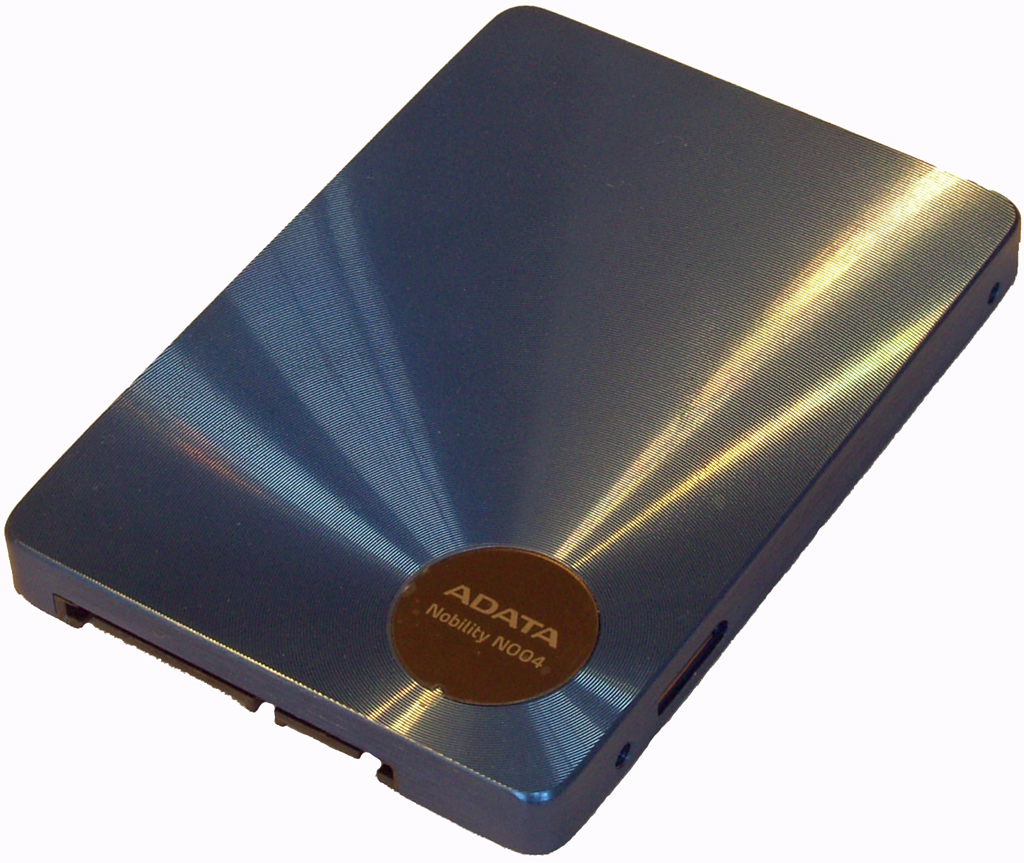
ADATA’s HDD/SSD storage portfolio is made up of six separate external hard drive series and three internal SSDs. The new N004 series adds three additional USB3/SATA combo SSD drives to the line-up (64GB, 128GB and 256GB) :
As the N004 isn’t designed solely for external use, the casing dimensions and connector placement are pretty much standard fare for an SSD, the only exception being the inclusion of the USB 3.0 port on the right side of the drive (cable included).
Let’s take a look at the USB 3.0 performance figures:
ADATA N004 128GB USB 3.0 Performance
  Sequential Read (128KB) Sequential Write (128KB) Random Read (4KB) Random Write (4KB)
ADATA N004 128GB USB 3.0 185.79 MB/s 167.85 MB/s 21.4 MB/s 14.62 MB/s
OCZ Enyo 128GB USB 3.0 178.1 MB/s 169.6 MB/s 21.9 MB/s 7.9 MB/s
ADATA N004 128GB USB 2.0 32.87 MB/s 22.56 MB/s 7.81 MB/s 7.81MB/s
OCZ Enyo 128GB USB 2.0 35.0 MB/s 31.1 MB/s 7.8 MB/s 7.4 MB/s
Corsair Nova 128GB SATA 222.1 MB/s 184.0 MB/s 37.5 MB/s 14.4 MB/s
A little bit of ground given up against the the Enyo as a USB 2.0 drive when it comes to write speeds, although as a USB 3.0 device the N004 seems to be the drive to go for.  There is one irksome niggle with the N004; end-user firmware updates aren't possible. It's not a complete deal breaker in our eyes, though small performance enhnacing firmware changes are always welcome - no chance of those here.

We also checked out if garbage collection works over USB (no Trim over USB obviosuly):
Performace after torture

After 1 hour...
 
 
After several hours...
While the garabage collection obviously works, it isn't as good as what we've seen from Toshiba. If absolute transfer speed under constant usage is of the essence, the Indilinx Barefoot controller isn't the one to go for.

The nitty -gritty of give and take against present competition from OCZ is all in the pricing:
ADATA N004 Pricing
  64GB 128GB 256GB
ADATA N004 $139 $213 $699
OCZ Enyo $199 $305 $715
At 64GB and 128GB capacities, the N004 series is conderably cheaper than the Enyo. This is a big deal when you consider that the Enyo is limited to USB operation only. Obviously outright performance of the N004 isn't going to rival newer controller architectures over the SATA bus, but as a combination drive it stands alone right now.
Read more...